
- Published on
I Built My Own SEO Analyzer with Jev
- Authors

- Name
- Matt Lam
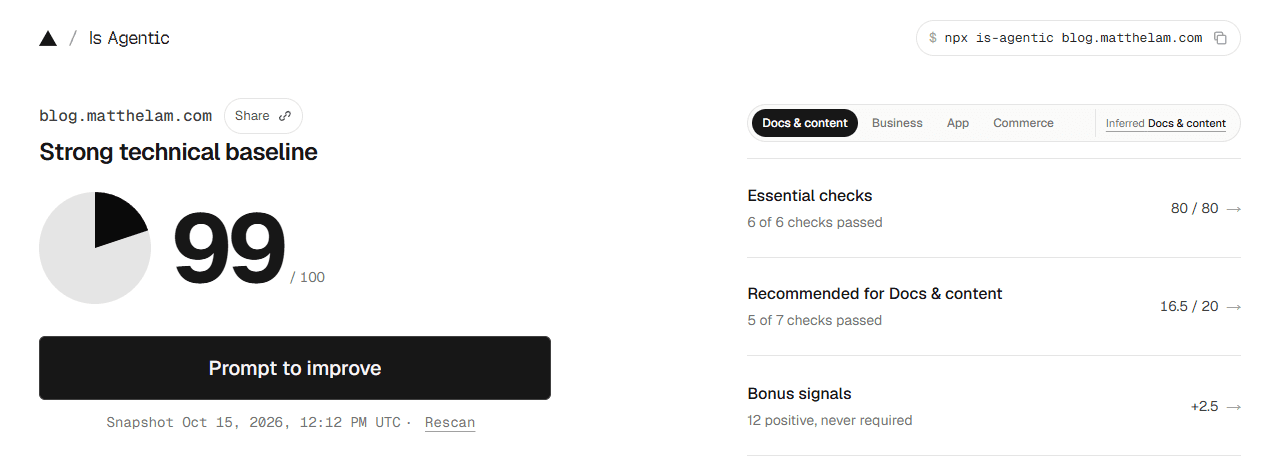
This blog scores 99 out of 100 on is-agentic's agent readiness scan. By achieving that, I now have all the 'bits' for SEO, but I felt like it still didn't address the root problem: the content. Does my page actually deliver on what I'm trying to tune it for? Am I advertising it on what it's truly about?
So I built something to answer those questions. seo-jev-analyzer uses Jev, a decision model rather than a chatbot, to score whether a page answers the question people search for, consistently enough to test a title or description before you publish.
Why I built it
I needed a way to get quicker round trips when tuning my content for SEO.
Google's own guidance says the content is what matters most. Its SEO Starter Guide says creating content people find compelling and useful "will likely influence your website's presence in search results more than any of the other suggestions in this guide", and it asks you to "think about the words that a user might search for to find a piece of your content."
Tools like is-agentic have already solved the technical side of this. There wasn't much out there that really helped an author figure out whether the page they just created has a clear purpose, and whether that purpose lines up with the search terms they think should be bringing people to it.
What it scores
For each page you write an intent statement, the question the page should answer, and ten search terms you expect people to use to find it. Jev then rates, on a 0 to 1 scale, how central each term is to the page and how well the page answers the intent (the intent fit).
Score = (sum of the ten term ratings) × intent fit, from 0 to 10.
It scores each page twice, and each score answers one of my two questions:
- The whole page score reads the body and the metadata. Does my page actually deliver on what I'm tuning it for?
- The metadata score reads only the title, description, Open Graph tags and JSON-LD, which is what a search result shows. Am I advertising it on what it's truly about?
Multiplying by intent fit is the important part, because it discounts keyword stuffing. The tool's guide shows it with three versions of the same page's metadata:
| Metadata | Term sum | Intent fit | Score |
|---|---|---|---|
| A casual title, no description | 0.68 | 0.006 | 0.00 |
| A title and description that answer the question | 3.40 | 0.99 | 3.37 |
| A list of the ten terms | 5.44 | 0.37 | 1.99 |
The list of terms has the most keywords in it, and it still loses to the version that answers the question.
Why Jev
Jev is a big part of why this works, because of the niche it fills in AI. Most of the AI we use day to day generates text. If you ask a chat model to rate a page, you get prose back with a number somewhere in it.
Jev, TypeSafe's decision model, works differently. You give it text and a typed question, and it returns a probability for every possible answer instead of writing one. In seo-jev every rating is a question with five levels, from "not mentioned" to "the page's central subject", and the rating is the probability-weighted level.
It's also cheap: $0.042 per million input tokens, and output is free. That's what makes the quick round trip practical. I can score a draft several times while I'm still editing it.
Can you trust a number from a model?
That's a fair question to ask of any new tool, so I tested it. The consistency report froze the text of 10 public pages, so only Jev could vary, and scored each page 100 times on both scores: 6,000 Jev requests in all.
- The largest standard deviation of any score was 0.097 on the 0 to 10 scale.
- 99.7% of single runs landed within ±0.19 of their 100-run mean.
- 17 of 20 metadata edits were detectable from one run before and one run after.
That ±0.19 is the tool's noise floor. Any change smaller than that counts as level, not an improvement.
The report is upfront about its limits: one Jev version, one day, ten English pages. In its own words, it "measures consistency, not correctness".
Why it helps tuning
This is where the quicker round trip comes in. The tool's test_revision scores an edit against the live page before anything is published.
Part two of my Azure Entra ID SSO series is a good example. The page itself delivered, with a whole page score of 7.62. But I wasn't advertising it on what it was truly about:
| Before | After | |
|---|---|---|
| Description | "A user guide to configuring SAML and role claims mapping through Entra ID group claims…" | "To set up an Entra ID enterprise application for Sitecore SAML SSO, create a non-gallery app, set the identifier and reply URL, add a groups claim with Object IDs…" |
| Term sum | 7.76 | 7.99 |
| Intent fit | 0.37 | 0.75 |
| Metadata score | 2.87 | 6.01 |
| Whole page score | 7.62 | 7.78 |
The search terms barely moved. What changed was a description that answers the question the page is for, and Jev's probabilities show the shift:
The page was already delivering. The description just wasn't advertising it. The metadata now carries 77% of what the whole page scores, up from 38%.
Beside the traditional tools
I use both, and I value them for different things. is-agentic makes sure machines can read the site. seo-jev tells me whether the content behind it delivers on what I'm tuning it for, and whether I'm advertising it on what it's truly about.
One thing I learnt along the way: the ten terms have to come from researching the question, not from the page. When I drafted terms from the post itself, it scored higher (metadata 4.12, against 3.11 for terms researched from the intent alone), but that was the page being marked against what it already said.
What isn't right yet
The ceiling. Scores run from 0 to 10, but a page is never going to reach 10, and the theoretical ceiling isn't clear. So what counts as success isn't clear either.
For now I use the whole page score as the practical ceiling for the metadata, which is where that 77% comes from. It seems to work fine for me, but I wouldn't call it settled.
Run your own
The hosted instance runs on my own Jev account, and it's not for commercial use, so I'm happy to share the code but not the API. It's cheap, but I'm not ready for it to be scaled out in case it becomes popular.
The code is public. seo-jev-analyzer is MIT licensed and runs as a web app, an MCP server with eight tools (including score_page and test_revision) and an HTTP API. You bring your own TypeSafe key from the TypeSafe console and set an access password. The app refuses to run in production without one, because an open deployment spends your Jev credits.
The MCP connectivity is there for a reason. As someone interested in building agents on the Sitecore Agentic Studio platform, I enabled MCP on the analyzer so I can integrate it into Agentic Studio, where I often hear that the relevance of content is a key concern.
The tuning loop I used on this blog is packaged as a Claude Code skill: seo-tuning-skill.
/plugin marketplace add matthelam/seo-tuning-skill
/plugin install seo-tuning@seo-tuning-skill
So before you tune your next page, ask the two questions. Does it actually deliver on what you're tuning it for? Are you advertising it on what it's truly about? seo-jev-analyzer gives you a number for both.